




In politics, nothing is stranger than a spark igniting from within the house itself.
This is exactly what happened in Morocco when a seemingly offhand parliamentary statement became a political earthquake, revealing deep contradictions within the majority and reopening the question: who has the right to report corruption, and who has the power to silence it?
The affair began with a phrase that seemed metaphorical on the surface but carried a burning truth underneath: “Grinding paper instead of flour.”
Spoken by Ahmed Touizi, leader of the Authenticity and Modernity Party (PAM) — a party sharing power with the National Rally of Independents and leading the Ministry of Justice — this statement created a rare scenario: a ruling party accusing economic sectors of injustice and corruption in a matter affecting the daily sustenance of the poorest citizens.
Cracks in Power or Awakening Conscience?
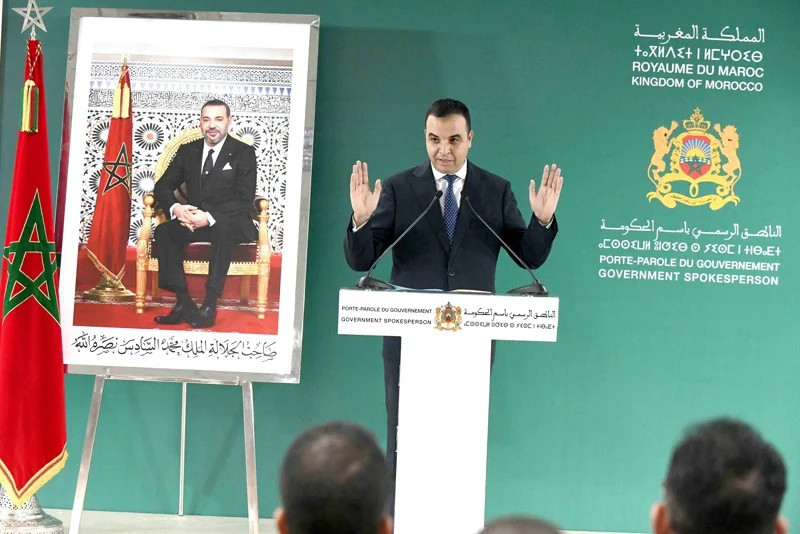
When Deputy Minister Mustafa Baytas responded that the public prosecutor had “taken action,” the government appeared to have chosen institutional defense over political confrontation.
But did the state truly act, or did it merely use legal language to suppress political sparks?
Is it conceivable that major companies are accused of mixing paper with flour, and the response is merely a statement on an “ongoing judicial inquiry” without a clear government stance to reassure the public?
Notably, this conflict did not originate from the opposition, but from within the majority itself, raising a deeper question:
Does PAM experience a duality in its discourse between what it says in Parliament and what it practices in government?
Or did Touizi articulate what many within decision-making circles dare not reveal?
Paper and Flour… Symbols of a Troubled Political Scene
For the ordinary citizen, flour symbolizes daily life. When their bread is compromised, so is their dignity.
Thus, Touizi’s statement was not merely a “slip of the tongue,” but a tremor in the collective consciousness of Moroccans living under years of rising prices and monopoly suspicions.
But the symbolism runs deeper.
The paper in this story is not just an additive to flour, but a metaphor for corruption hidden behind documents, invoices, and reports.
When Touizi later clarified that he referred to “invoice falsification,” he described the essence of the current Moroccan scene: corruption that has mastered the language of law itself.
Parliament on the Edge of Government
Here lies the paradox: while the Ministry of Justice under Abdelatif Ouahbi enacted laws limiting the ability of associations to report political corruption, a parliamentarian from the same party performed the exact same act within the parliamentary chamber!
Is this coincidence, or a stark political contradiction?
This moment exposes the fragility of the relationship between legislative and executive powers and confronts the state with a painful question:
How can associations be barred from reporting corruption while accusations rise from within Parliament, shaking trust in oversight institutions?
The paradox: those meant to protect the law now complain of their inability to confront corruption.
The Public Prosecutor as a Political Shield?
When the government refers any dossier to the public prosecutor, it implicitly admits a lack of courage to intervene or take a political stance. But is this not a form of “responsibility evasion”?
Judicial investigations do not always reassure the public, as they are inherently slow and shrouded in secrecy, while the crisis is primarily political and ethical before being legal.
The government resorts to institutional language to avoid essential questions: who monitors the quality of subsidized goods? Why are the results of previous investigations in similar cases not published? And why, when someone within the system speaks of corruption, are they surrounded by criticism and accused of “exaggeration”?
Whistleblowing: From Civic Duty to Risk
Reporting corruption has transformed from a civic practice to a potential crime, from a national duty to a personal risk. Each new law narrowing the space for initiative erodes collective faith in the possibility of internal reform. Because when the state fears the whistleblower, it fears, at its core, facing its own reflection.
Public Conscience Between Silence and Suspicion
The scandal — or incident, as some call it — is nothing but a mirror reflecting the strained relationship between citizens and the state.
A population that has lost trust in official accountability mechanisms now sees a ruling party parliamentarian describe the hardships of the poor as “ground paper.”
Is this phrase alone enough to shake the image of authority?
Does Morocco’s political system have the courage to turn this shock into a moment of collective reflection?
Open Conclusion: Politics Consuming Itself
The story is not just about “paper flour,” but the symbolic transformation this dossier reveals: a member of the system speaks of the system’s corruption, and the government responds that “the law is in action.”
It is as if we face a scene summarizing all governance dilemmas in Morocco: those who dare to speak are accused of exaggeration, and those who remain silent are accused of complicity.
Thus, the truth, like fine flour, is sifted through the hands of power, while the paper — ashes of laws and complaints — flies before those seeking both bread and justice.
And the question remains open:
Does reform in Morocco require the courage to speak the truth, or the courage to endure it?