




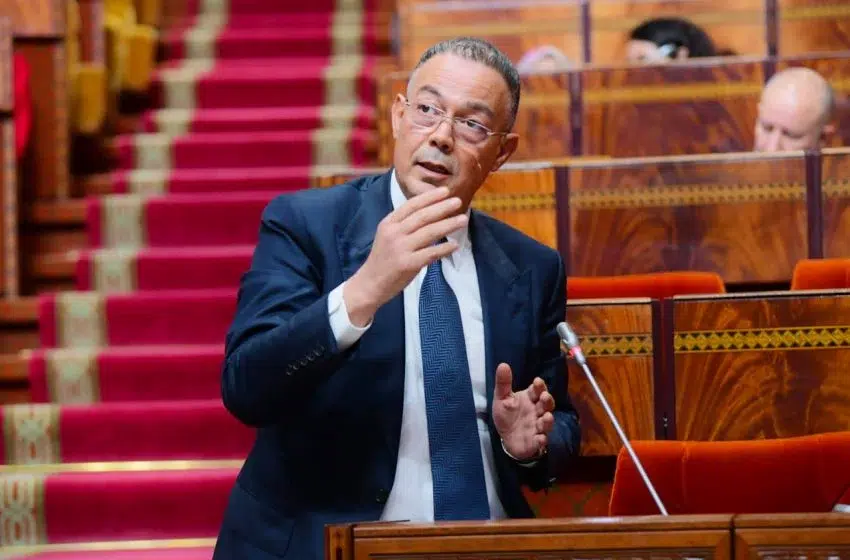
When Fouzi Lekjaa, the minister delegate in charge of the budget and president of the Moroccan Royal Football Federation, speaks about the cost of stadiums and development related to the World Cup, it cannot be considered a mere traditional government statement. In a few minutes, the discussion intersects politics, economy, sports, and long-term development plans, revealing a vision of Morocco seeking to achieve a comprehensive strategic shift, from infrastructure to public health.
Lekjaa says: “Why boycott Hakimi? Hakimi was born in Ksar El Kebir, he ate bissara with Simo.” In this simple sentence, there is more than just a defense of a player. It sends multiple messages: about local belonging, recognition of daily sacrifices, and rejection of situational or selective approaches that try to marginalize certain players. Today, is sports merely about performance on the field, or is it a reflection of social and political power zones within Morocco?
Lekjaa emphasizes that organizing the World Cup is not just a sports project but a “manifestation of a strategic vision for our country,” creating added value, growth opportunities, and boosting employment. But can sports alone drive national development? Or has it become a symbolic tool to measure the state’s capacity to execute complex projects, extending beyond the stadium to all sectors of society?
The minister links major matches to investment in health and infrastructure: from stadiums to university hospitals, from airport development to enhancing health services, all projects accelerating thanks to the pressure of the World Cup. Here arises a fundamental question: would these projects have been completed without the major deadlines imposed by a global event? And does society deserve millions of dirhams invested to speed up implementation, even if Morocco does not actually host the World Cup?
Lekjaa clarifies that “the cost of building stadiums does not fall under the general budget,” revealing that the total cost associated with the World Cup is around 3 billion dirhams, including 1.6 billion for the National Railway Office. From this perspective, the World Cup is not merely a football event; it is a comprehensive economic and social development project, connecting north to south and east to west, in what Morocco calls “2030.”
At the same time, Lekjaa addresses rumors and doubts about Morocco’s capabilities, speaking of the “conspiracy linked to stray dogs and fabricated images.” This raises an important question: why does sports turn into a field for imaginary conspiracies? Does the attempt by outsiders to question the state’s competence reflect a trust crisis or a complex political game?
Ultimately, Lekjaa’s discourse invites reflection: development is not a temporary project linked to the World Cup but an integrated process targeting all sectors, primarily health and infrastructure. It is a call to reconsider state priorities and understand that when sports intersect with economy and politics, they become a mirror of society, reflecting its ambitions, conflicts, and challenges.
The reader is invited to ponder: can Morocco 2030 be achieved without major events like the World Cup? What is the social and political cost of investing in accelerated projects? And does sport become a platform to strengthen national development or merely a symbolic tool of control and influence?