




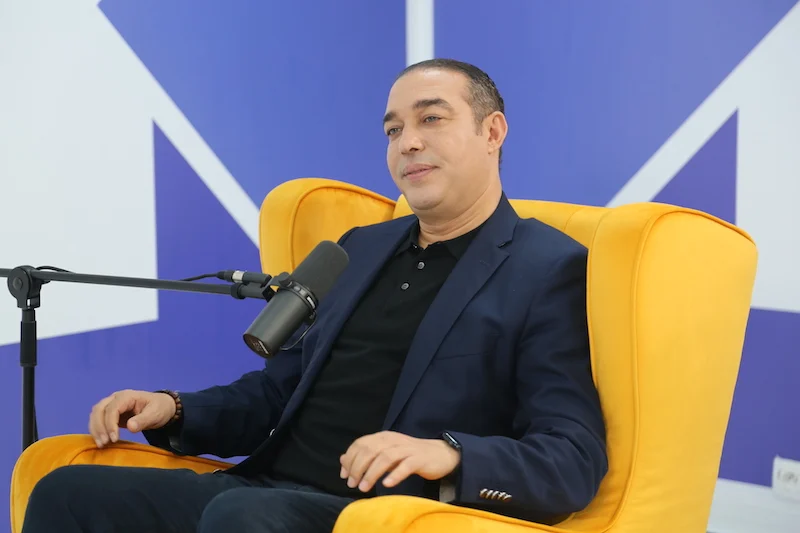
At a defining moment in Morocco’s contemporary history — when political disillusion meets the unfulfilled dreams of a restless generation — Mohamed Ouzzine, Secretary-General of the Popular Movement Party and former Minister of Youth and Sports, turned to Generation Z on Instagram.
His video wasn’t a mere communication gesture; it was a political statement — a bridge between a skeptical generation and institutions struggling to remain relevant.
From his opening remarks, Ouzzine acknowledges the range of reactions he received: some understood his message, others doubted it, and some dismissed it altogether.
This diversity reflects a deeper malaise — a national crisis of trust that transcends age, cutting across social and political divides.
It is no longer the youth who have abandoned politics, but rather the political system that has failed to earn their trust.
Ouzzine points to recent protests — from teachers to young activists — who bypassed political parties and appealed directly to the King.
This direct connection reveals a disconnect between citizens and political intermediaries, and highlights the monarchy’s continued responsiveness to social grievances.
By invoking the royal discourse centered on social justice, Ouzzine positions the monarchy as a steady anchor of reform — but one whose directives must find resonance in tangible policies.
Yet, the essence of his message lies elsewhere: Ouzzine calls on the youth to move from the streets into institutions.
For him, true change begins within — inside parties, within political systems, through participation rather than protest.
The street expresses anger; politics channels it into transformation.
But this call raises a glaring question:
Are Morocco’s political parties truly ready to welcome this new generation?
Most remain closed structures dominated by aging elites who guard their influence jealously.
Young entrants often find themselves fighting for legitimacy, navigating internal hierarchies and unwritten rules where loyalty outweighs merit.
Climbing the ladder in such an environment can be more a battle of endurance than a test of competence.
Here lies the paradox of Ouzzine’s message: he invites the youth into a space that resists their presence.
To join a party in Morocco is to confront a system that fears renewal.
So how can one change a structure that barely allows entry?
And can generational renewal happen without deep structural reform within the parties themselves?
Research consistently shows that Moroccan parties suffer from aging leadership and weak internal democracy.
This reality pushes many young people toward alternative forms of engagement — digital activism, NGOs, or independent movements — spaces perceived as more transparent and authentic.
Still, Ouzzine insists that change must come “from within.”
“If you think parties are corrupt,” he says, “join them and clean them up.”
It’s a bold challenge — idealistic, even — but one that collides with entrenched realities.
For how can one rebuild trust in institutions that remain structurally resistant to change?
Ouzzine’s speech, however, goes beyond criticism; it carries faith — in youth, in the nation, and in the enduring moral authority of the monarchy.
He invokes Morocco’s historical continuum — from Mohammed V to Hassan II, and now Mohammed VI — to underline that progress has always been a shared journey between leadership and people.
He also draws inspiration from Moroccan athletes, whose global triumphs symbolize what confidence and discipline can achieve.
But the crucial question remains: can Morocco’s youthful energy translate athletic glory into civic engagement?
Perhaps it can — if given space, trust, and responsibility.
In the end, Ouzzine’s message functions less as a speech and more as a mirror — reflecting the contradictions of a nation caught between frustration and renewal.
It asks:
Can this generation of doubt transform its skepticism into participation?
Will the parties open their doors before irrelevance closes them?
And will the state move beyond symbolic gestures to embrace real inclusion?
Between disillusion and hope, Morocco stands at a crossroads — where rebuilding trust is no longer a slogan, but a national project in the making.