




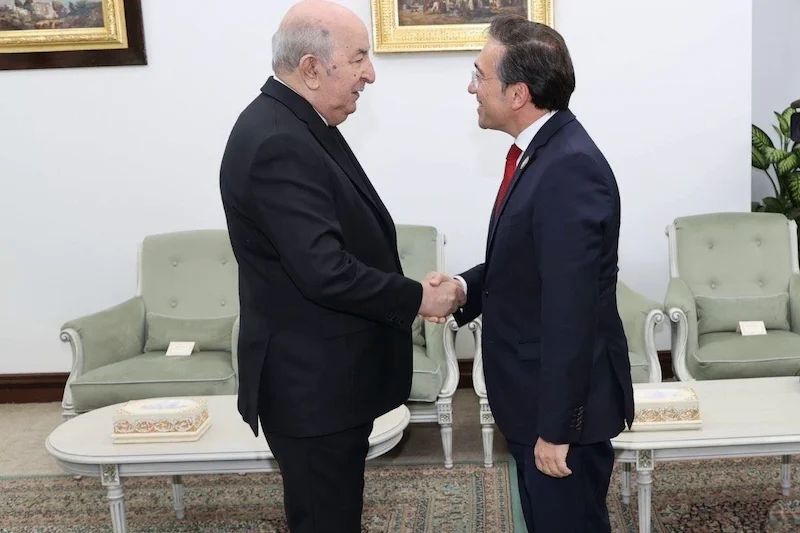
The reception of Spanish Foreign Minister José Manuel Albares by Algerian President Abdelmadjid Tebboune last Thursday was far more than a routine diplomatic engagement. The announcement of reactivating the Friendship, Good Neighbourlinessand Cooperation Treaty signed with Madrid in October 2002—far from being a procedural act—signals a strategic pivot within Algeria’s regional positioning. This move reflects a pragmatic reassessment of traditional pressure mechanisms, especially after a period of sharp tension between Algiers and Madrid over Spain’s stance on the Western Sahara issue.
Rather than a mere technical normalization, this step reveals an awakening to the limitations of economic levers as tools of diplomatic conflict and the high cost of ruptures driven by ideological motives. The leadership in El Mouradia appears to have realized—albeit late—that the price of breaking ties with Spain due to its support for Moroccan autonomy in the Sahara outweighed the expected benefits. This awareness marks a shift in Algeria’s foreign policy logic, from confrontation to balancing complex geopolitical realities.
Failed Pressure and the Spanish Position
Algerian political analyst Rafik Bouhlal describes the treaty’s reactivation as a sign of diplomatic retreat, noting that it came without any meaningful change in Spain’s unwavering position on the Sahara issue. For Bouhlal, this move represents an implicit acknowledgement of the failure of Algeria’s pressure strategy: suspending relations did not succeed in altering Spanish convictions in favor of Moroccan autonomy. Instead, it turned the diplomatic confrontation into a strategic loss on all fronts.
Bouhlal also highlights the fragility of using energy supplies as political bargaining chips in the Mediterranean context. Suspending gas flows through the Moroccan pipeline produced costly blowback for Algeria’s treasury, while Spanish companies deepened their economic partnerships with the Moroccan market.
He further draws attention to the stark economic disparity between Spain and Algeria—Spain’s GDP far surpassing Algeria’s—undermining any notion of economic parity between the two. According to Bouhlal, Morocco’s diplomatic successes since 2020 in the international arena have cornered Algeria, forcing it back towards Spain after a series of lost diplomatic bets.
Constrained Repositioning and Loss Management
Strategic affairs researcher Hicham Mouta’added argues that the treaty’s reactivation should not be seen as a purely technical step, but as a forced strategic repositioning in response to rapidly changing geopolitical dynamics. In 2022, he notes, Algeria attempted to use bilateral relations as a punitive pressure tool on Madrid for its support of Morocco’s autonomy plan. This bet, however, did not yield the desired results.
According to Mouta’added, the shift also reflects a late realization that tying all aspects of foreign policy to the Sahara dossier is no longer effective in a global environment where priorities are governed by strategic pragmatism. European countries—Spain foremost among them—now treat this issue as an internationally framed matter, anchored in the dynamics of the UN Security Council rather than as a bilateral lever for pressure.
The expert adds that the Algerian decision also reveals internal pressure within the decision-making apparatus to reconcile ideological commitments with practical needs. Sustaining the break with Madrid would have further restricted Algeria’s economic room for maneuver in an uncertain international setting, where diversifying partnerships is essential.
Conclusion: Impacts and Reconfigurations
Ultimately, Algeria’s recent move should not be dismissed as the simple renewal of a two-decade-old treaty. It stands as a quiet political signal, indicating the erosion of traditional pressure strategies and a pragmatic acknowledgment that managing regional issues requires mutual interests and nuanced balance. It also underscores the limitations of conventional instruments of influence in a rapidly transformed strategic environment, where realistic diplomacy is paramount.