





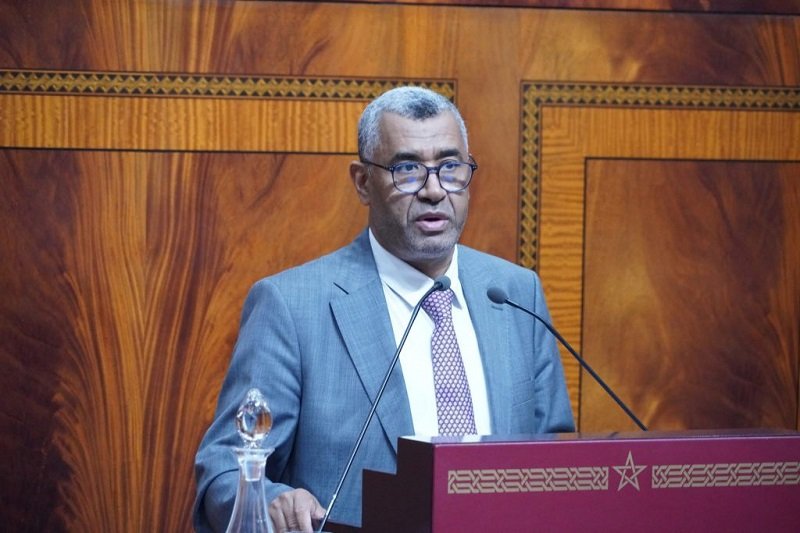
Bouanou raises the stakes: Who controls drug policy? The public interest or the lobbies?
In Moroccan politics, not all interventions are equal. Some pass as ordinary news, while others turn into warning sirens revealing deeper issues and striking at the heart of public governance. The intervention of Abdellah Bouanou, head of the parliamentary group of the Justice and Development Party, clearly belongs to the latter category.
He did not limit himself to criticizing a drug deal or questioning an administrative procedure; he put the Ministry of Health and the government as a whole under serious accusations of conflict of interest, abuse of influence, and the existence of companies linked to government members obtaining sensitive contracts in a sector where mistakes are unacceptable.
Ministry of Health’s statement… a response or an attempt to kill the flames?
The Ministry of Health issued a late-night statement that, according to Bouanou, looked more like a “rhetorical exercise” than an official answer. It did not clearly deny any benefit for the concerned minister, nor did it present documents, data, procedures, or any technical clarification capable of eliminating doubts.
In journalistic terms: a statement with no content.
Thus, the key question becomes:
Was this statement meant to inform the public… or to obscure the truth?
Timing… a different language of politics
One of Bouanou’s strong arguments concerns the timing: the ministry published its response around midnight, while parliament was deeply engaged in the budget amendment debate. For him, such timing carries a “suspicious message”, possibly aimed at pressuring parliament or, at least, disrupting the public debate around health sector contracts.
Which raises another question:
Why is a matter this sensitive treated through “midnight statements” instead of being handled transparently and responsibly?
ATU… a mysterious acronym frequently mentioned but rarely explained
Among Bouanou’s most serious allegations is the file of Temporary Use Authorizations (ATU), a procedure understood only by very few in the sector, but which is — according to him — being used “intensively and in an unprecedented manner.”
He called for the publication of the list of beneficiary companies and the identities of their owners — a request that appears quite normal in a country committed to transparency.
Here are the essential journalistic questions:
-
Who exactly benefits from the ATU system?
-
Do these benefits intersect with the interests of government officials?
-
What are the granting procedures? Who oversees them?
-
Has the ATU system become a backdoor for approving certain drugs outside regular regulations?
The Chinese drug deal… the story that fueled the controversy
The explosive point in this case is Bouanou’s statement that the Minister of Health granted a drug contract to a company belonging to another member of the government (Barada), and that the drug was imported from China before being withdrawn later due to “unreadable Chinese labeling.”
This does not look like a simple “technical mistake”… but rather a clue toward a network of economic relationships within the government itself.
Logical question:
How can a drug contract be granted to a company owned by a government member without triggering monitoring mechanisms or objections?
And if the ministry claims that “no privilege has been granted”, then why not provide evidence?
The political dimension… a direct confrontation with power logic
Bouanou is not merely attacking a sector; he is challenging a political logic that normalizes conflict of interest and treats it as mere electoral noise.
His claim that the ministry has become “the spokesperson for lobbies” is not a casual remark — it is a direct accusation that health decisions are being driven by economic pressure rather than by public service and quality criteria.
Thus arise the major political questions:
-
Are we facing a health governance crisis or a political trust crisis?
-
Will the majority accept the creation of a fact-finding commission?
-
If not, what will this refusal mean to the public?
-
Will parliament become a place where disturbing voices are silenced instead of where truth is revealed?
Journalistic conclusion, not a political one
Bouanou’s statements — whether one agrees with him or not — have pushed a critical file into the spotlight and placed the Ministry of Health before its duty of transparency. In a country struggling with a fragile health system and high treatment costs, any suspicion of conflict of interest becomes a public interest matter, not a simple dispute among MPs.
The essential question today is no longer:
Did Bouanou exaggerate?
But rather:
Why has the ministry not yet provided clear evidence refuting his claims?
Until that happens, the case remains open…
and the questions of transparency remain hanging on the neck of politics.