





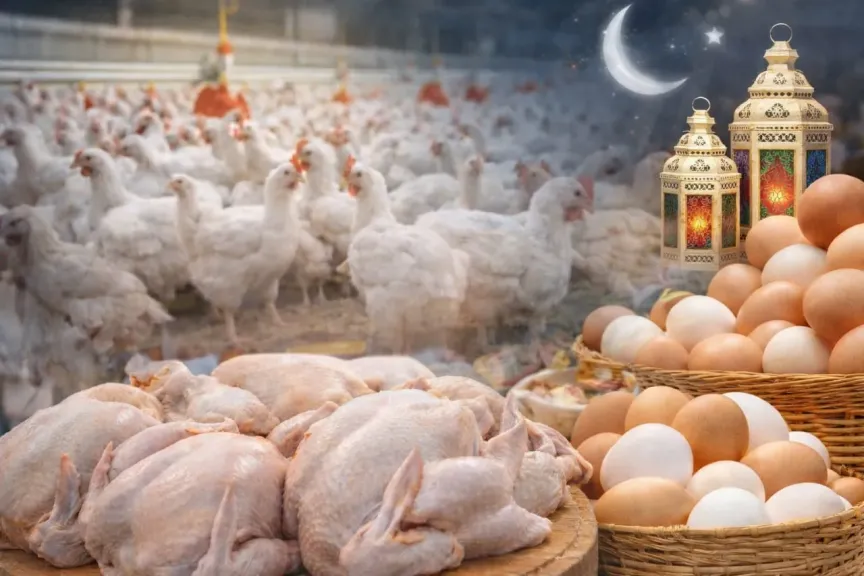
At a particularly sensitive time, with the holy month of Ramadan approaching—when food demand naturally rises—the issue of poultry prices has resurfaced, not just as a temporary consumer concern, but as a deeper indicator of structural imbalances in the marketing and distribution system, and of the real fragility of consumer protection in a market that is supposed to be free and competitive.
The Moroccan Consumer Protection Observatory has sounded the alarm, warning against unjustified fluctuations in chicken prices, despite abundant production and falling prices at farms. This discrepancy highlights a stark gap between supply at the source and retail market prices. This gap cannot be explained merely by economics; it raises the question of authority in the distribution chain: who truly sets the price—the producer, the intermediary, or those who control the information?
The Observatory does not stop at describing the phenomenon; it connects it to its legal framework, noting that these practices violate key market regulations: the Consumer Protection Law and the Law on Price Freedom and Competition. The concern is not only the high prices themselves but the lack of transparency, opaque marketing channels, and weak monitoring mechanisms.
Statements by Hassan Aït Ali, head of the Observatory, paint a picture of an unbalanced market, where prices fluctuate between 11 and 30 dirhams per kilogram within days, without any fundamental change in production, feed costs, or actual demand. What truly changes is the position of intermediaries in the chain and their ability to control the flow and information—and thus the price.
Here, the poultry price surge emerges as a complex phenomenon: it is not caused by scarcity, but by an unfair market structure. It does not reflect production costs but intermediary profit margins. And it is not a one-time crisis but a recurring pattern during every high-demand season: Ramadan, holidays, and social occasions.
It is also noteworthy that this issue coincides with growing public concern over egg prices, a staple on the daily table, highly sensitive to distribution disruptions. Poultry and eggs together form the backbone of popular protein sources, and any imbalance affects not only purchasing power but social food security as well.
From a deeper perspective, this scenario is a direct consequence of market liberalization without true competition conditions. A market that is theoretically open remains practically closed to small producers, concentrated in the hands of a few large intermediaries who evade real accountability and strict margin monitoring.
In this equation, the consumer is not an economic actor but a weak link, bearing the cost of every imbalance without tools for negotiation, knowledge, or effective legal protection. Even the Observatory’s calls to activate the Competition Council and strengthen monitoring remain, for now, more of a warning than concrete public policy.
The question, therefore, is not simply: why did chicken prices rise? But: why does this rise repeat every season? Why doesn’t production abundance translate into stronger purchasing power? And why does the consumer remain the only one paying the price of “market liberalization” without benefiting from it?
At its core, we face a crisis of trust in the marketing system, a governance crisis in price regulation, and a social protection crisis in a country where food has become a daily source of concern. Ramadan does not reveal the price surge—it exposes it: it lays bare the fragility of a market driven by rapid profit rather than food security logic.