




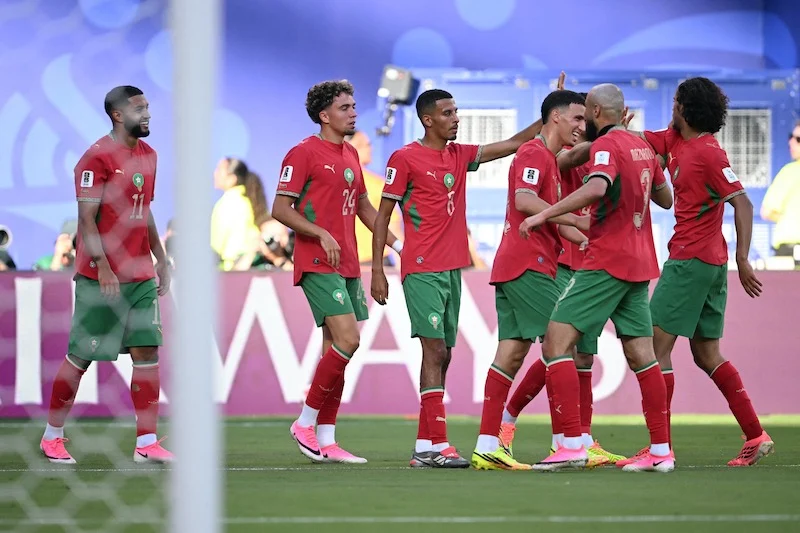
Morocco’s clash with Scotland in the second round of the 2026 FIFA World Cup group stage is far more than an ordinary football match. Beyond the ninety minutes lies a broader struggle involving ambition, identity, and the pursuit of international recognition. On one side stands a Moroccan generation determined to cement its place among football’s elite. On the other stands a Scottish side eager to transform its long-awaited return to the world stage into a historic achievement.
Since the final whistle of the opening draw against Brazil, discussions within Moroccan football circles have moved well beyond the result itself. What captured attention was not merely the point earned, but the image projected by the Atlas Lions. Morocco no longer appears to be a guest at football’s grandest stage. It increasingly resembles a nation that belongs there.
This transformation is not solely the legacy of the remarkable 2022 World Cup campaign in Qatar. It is the outcome of years of investment in infrastructure, player development, coaching structures, and long-term planning. Morocco has gradually evolved from a team seeking occasional upsets into one expected to compete with the world’s strongest nations.
Yet football has little regard for history. Past achievements provide confidence but never guarantees. The challenge presented by Scotland differs significantly from the one posed by Brazil. If the opening match required defensive discipline and rapid transitions, this encounter demands creativity, patience, and the ability to break down an organized opponent.
Scotland arrives with ambitions of its own. Encouraged by victory over Haiti, the Scots view this fixture as a potential gateway to qualification. For them, Morocco is not merely another opponent but perhaps the most significant obstacle standing between them and the knockout rounds.
That reality illustrates how dramatically perceptions of Moroccan football have changed. For decades, many European teams approached matches against African opponents with an almost automatic sense of superiority. Today, the balance has shifted. Morocco is increasingly viewed as a genuine contender capable of challenging established football powers.
From a mathematical perspective, the stakes are enormous. A Moroccan victory would place qualification within touching distance and significantly reduce the pressure ahead of the final group match. Any other outcome, however, would reopen the race and force Morocco into a more complicated scenario.
Yet the significance of this match extends beyond points and standings. It represents a confrontation between two footballing projects. Morocco embodies a model built on long-term investment, youth development, and strategic planning. Scotland represents a nation seeking to reclaim a place it once occupied within the upper tiers of international football.
The tactical battle promises to be equally compelling. Morocco possesses speed, technical quality, and creative attacking options. Scotland relies on physical intensity, collective discipline, aerial strength, and set-piece efficiency. The contest therefore becomes a meeting of contrasting football philosophies as much as a fight for qualification.
One of the central questions concerns Morocco’s ability to manage the defensive spaces created by Achraf Hakimi’s attacking runs. His offensive contribution remains one of Morocco’s greatest strengths, yet it can also expose vulnerabilities during defensive transitions. Scotland will almost certainly attempt to exploit those areas whenever opportunities arise.
Conversely, Morocco’s high pressing game, which proved highly effective against Brazil, could become a decisive weapon. If the Atlas Lions succeed in disrupting Scotland’s build-up play and recovering possession high up the pitch, they may gain an early advantage and dictate the rhythm of the contest.
The match also carries historical symbolism. The last World Cup meeting between the two nations took place in 1998, when Morocco secured a memorable victory. Yet football has changed dramatically since then. Historical memories enrich narratives, but they do not determine contemporary outcomes.
As kickoff approaches, it becomes increasingly clear that the implications extend beyond the boundaries of Group competition. Every Moroccan victory strengthens the broader narrative of African football’s rise on the global stage. Every positive result challenges traditional assumptions about who belongs among football’s leading powers.
Ultimately, the most important question surrounding this encounter reaches far beyond the final score. Has Morocco genuinely entered the ranks of world football’s enduring powers, or does that status still require further validation through continued success?
The answer will not come from predictions, rankings, or commentary. It will emerge on the pitch itself—the place where ambition is tested, reputations are forged, and history is written.