





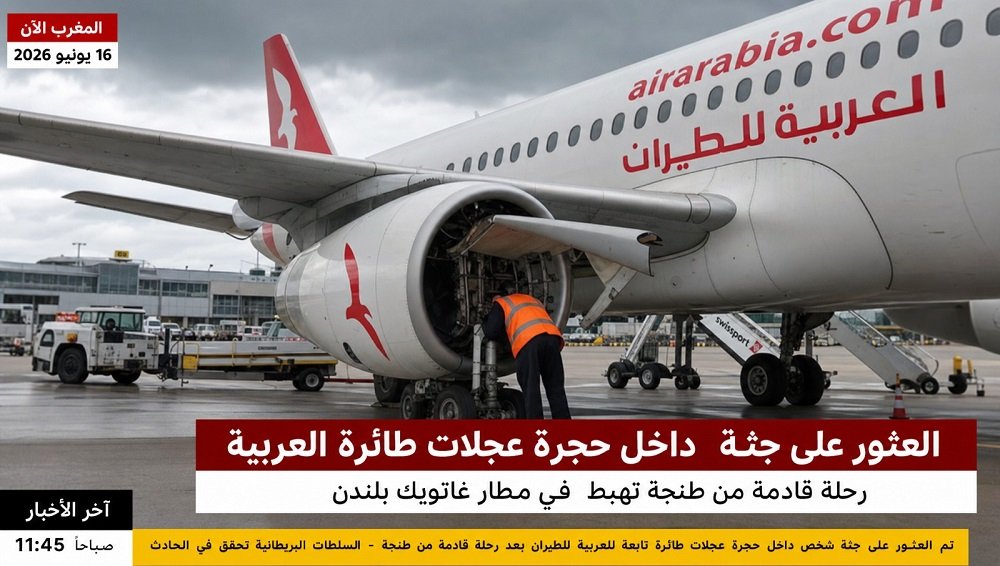
This is not a simple aviation incident, nor just another entry in the global record of accidents. The body found in the landing gear compartment of a flight from Tangier to London transcends the limits of a news story and becomes a heavier, almost existential question: what does it mean when a young man chooses to hide in one of the most lethal parts of an aircraft, fully aware that survival there is nearly impossible, simply to leave his country?
The shock comes from the shift in geography of death. It is no longer the sea, as in the familiar narratives of irregular migration, but the sky itself. Between metal structures, extreme cold, and oxygen deprivation, a different kind of tragedy unfolds. As the plane continued its route toward London, another silent journey was taking place inside it: that of a young man who appears to have lost faith that his homeland could still offer him a future.
The contradiction is striking. On one side, a country often presented as an emerging success story: expanding automotive industry, growing aerospace sector, massive infrastructure investments, modern ports and high-speed rail, and an economic diplomacy extending toward Africa and Europe. On the other side, a young man choosing extreme risk just to leave. How can these two realities coexist without contradiction?
Macroeconomic indicators, no matter how impressive, do not tell the full story. Daily life is measured differently: stable employment, the ability to build a future, access to education and healthcare, and a tangible sense of social fairness. When the gap between statistical progress and lived reality widens, trust begins to erode.
Irregular migration is no longer only an escape from poverty. In many cases, it becomes an escape from the absence of perspective. Graduates, skilled youth, workers—all increasingly share the same feeling: the future seems to be elsewhere. This is no longer purely economic; it is a crisis of imagined possibility.
Development strategies often rely on large infrastructure projects and structural investments. Yet development is only complete when it is felt. When young people believe that the benefits of growth do not reach them equally, or that opportunities are unevenly distributed, the promise of progress loses credibility.
The London airport incident also reflects a deeper transformation: that of collective imagination. Social media constantly exposes individuals to global lifestyles, creating a permanent comparison between “here” and “elsewhere.” This comparison generates both aspiration and frustration, gradually turning departure into a mental horizon.
A Moroccan proverb says: “No one flees a house of celebration.” Yet departures continue. This suggests that something in the relationship between citizens and their country has weakened—not in official discourse, but in perception and lived experience.
Ultimately, this tragedy raises less a question about an accident than about a model. How many more young people will risk their lives to leave? And what will it take for a country not only to develop, but to become a place where staying feels like a future worth choosing?