





AYOUB BOUADDI: MORE THAN A FOOTBALLER, A MODEL FOR A GENERATION SEEKING BALANCE
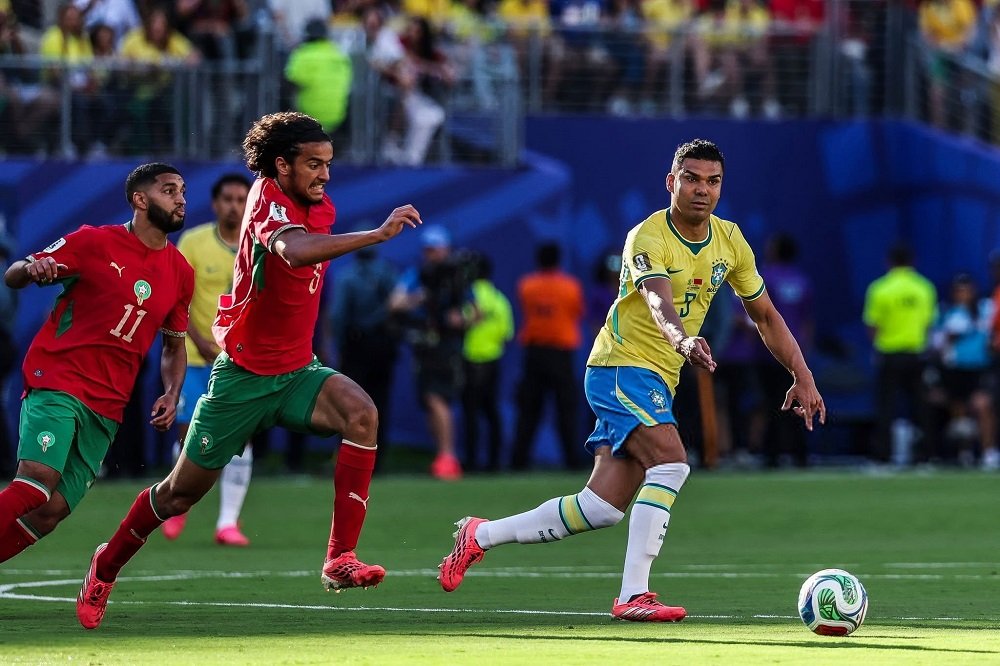
Modern football usually celebrates goals, dribbles and moments of brilliance. Yet, from time to time, a player emerges who sparks a different kind of conversation—one that goes beyond what he does on the pitch and explores how he thinks, how he was educated, and how his character was built. That is precisely what happened with Ayyoub Bouaddi, the young Moroccan midfielder whose remarkable performance against Brazil turned him into a subject of international attention.
At just eighteen years of age, Bouaddi did more than showcase technical quality and composure in midfield. He raised a deeper question: how can a teenager display such maturity, such emotional control and such authority against some of the most experienced players in world football?
The answer cannot be found solely within the ninety minutes of a football match. It begins years earlier, in the quiet stages of personal and athletic development. Great sporting achievements are rarely born overnight. They are the result of a long process in which talent meets discipline, education and long-term vision.
A closer look at Bouaddi’s journey reveals a profile that stands apart in an era where early specialization is often considered essential. Before dedicating himself entirely to football, he practiced several sports, including gymnastics, swimming, tennis, badminton and handball. This diversified background helped shape not only his physical abilities but also his coordination, adaptability and understanding of movement.
Yet what truly distinguishes the young Moroccan goes beyond sport. At a time when many teenagers see football as a shortcut to fame and financial success, Bouaddi remained committed to his academic development. His interest in mathematics, his participation in public-speaking competitions and his educational achievements reflect a different understanding of success.
This reality opens a broader debate that extends far beyond football itself. Are modern societies still presenting young people with a balanced vision of achievement? Or are they increasingly encouraging the belief that fame can replace knowledge and that financial success can compensate for intellectual development?
Contemporary football sometimes reinforces this illusion. Multi-million-dollar contracts, social media influence and constant media exposure create the impression that talent alone is enough. Yet for every football star, thousands of young players fail to reach the professional level. For them, education remains the most reliable foundation for the future.
This is precisely why Bouaddi’s story deserves attention. His experience demonstrates that sporting excellence and academic excellence are not opposing paths. In many cases, they complement each other. Mathematics strengthens analytical thinking. Public speaking develops confidence and communication skills. Education enhances decision-making under pressure.
His decision to represent Morocco also carries strategic significance. Over recent years, Morocco has built an ambitious policy aimed at attracting talented players from the diaspora. This silent competition between national federations has evolved into something much larger than football. It now involves questions of identity, belonging and confidence in a national project.
When a player raised and developed in France chooses to wear the Moroccan jersey despite having alternative international opportunities, the decision reflects more than sporting considerations. It highlights the growing credibility of Morocco’s football project and its ability to convince talented young players that their future can be written under its colors.
Bouaddi’s emergence is therefore part of a broader transformation. Since Morocco’s historic World Cup achievement, international perceptions of Moroccan football have changed dramatically. The country is no longer viewed as a team capable of producing occasional surprises. It is increasingly recognized as a football nation capable of consistently producing elite talent.
However, the greatest challenge begins now. Football history is filled with gifted prodigies whose rise was slowed by excessive expectations, media pressure and the temptations of early fame. Bouaddi’s long-term success will not be measured solely by what he achieved against Brazil, but by his ability to preserve the rare balance between ambition and humility, between achievement and continuous learning.
Ultimately, what makes his story compelling goes far beyond football. The world is not simply celebrating a promising young player. It is celebrating the return of an increasingly valuable idea: that talent, no matter how extraordinary, reaches its fullest potential only when accompanied by knowledge, discipline and the patient construction of character. And perhaps the real question is not how Ayyoub Bouaddi became a star at eighteen, but why examples capable of combining sporting excellence with intellectual achievement have become so rare in contemporary society.